Evaluations at Home
❋
Evaluations at The Gay Therapist
Understanding yourself shouldn't be so complicated.
Maybe you've spent years wondering if you're Autistic, have ADHD, or both. Maybe you've already done the research, talked with friends, taken a few screening questionnaires, and feel pretty confident about what you've discovered.
Or maybe you're just beginning to explore.
Wherever you are in that process, I offer virtual diagnostic evaluations for adults (18+) who want a better understanding of how their brains work. My approach is neurodiversity-affirming, LGBTQ+ affirming, culturally responsive and collaborative. Your experiences matter just as much as the information gathered through clinical assessment tools.
What Can I Be Evaluated For?
Three types of adult diagnostic evaluations:
An assessment exploring autistic traits and experiences, including communication, social interactions, sensory processing, repetitive behaviors, routines, and developmental history.
We also explore masking, burnout, and the ways your environment, culture, and identity may have influenced how autism shows up throughout your life.
❋ Autism Evaluation
❋ ADHD Evaluation
An assessment exploring attention, executive functioning, impulsivity, hyperactivity, emotional regulation, and how these experiences have affected different areas of your life.
We look beyond common stereotypes about ADHD and consider how your experiences may have changed from childhood to adulthood.
❋ Combined Autism + ADHD Evaluation Evaluation
Autism and ADHD can occur together. Sometimes, characteristics of one may mask or complicate how the other is recognized.
A combined evaluation considers both, including how they may interact in your daily life.

An Evaluation That Considers Your Whole Life
Traditional approaches to autism and ADHD assessment have not always recognized how neurodivergence presents in adults, particularly people whose experiences don't match familiar stereotypes.
My approach intentionally makes room for people who have spent much of their lives masking, adapting, or having their experiences misunderstood.
This includes LGBTQ+ people, transgender and nonbinary adults, BIPOC communities, and people exploring neurodivergence later in life.
We consider how trauma, mental health, culture, gender, relationships, and your environment may overlap with or influence your experiences.
You don't need to fit a stereotype to get an accurate evaluation.
What Does the Evaluation Process Look Like?
-
The process is virtual, collaborative, and designed to give us time to understand your experiences. Reach out through the contact form and let me know what you're looking for: an autism evaluation, an ADHD evaluation, or both.
We'll determine whether the evaluation is appropriate for your needs and go over scheduling, pricing, and the next steps.
-
We'll meet for approximately 2–3 hours for an individual autism or ADHD evaluation, or 3–4 hours for a combined evaluation. Sessions can be divided into shorter appointments if needed.
Together, we'll review your social, developmental, educational, and mental health history.
You'll also complete questionnaires and assessment measures. When appropriate and with your permission, additional information from someone familiar with your history may be included.
This isn't a test you pass or fail. It's an opportunity to better understand your experiences.
-
After our interviews, I'll review the information we've gathered, assess it against diagnostic criteria, and prepare a written report.
Your report will include:
A summary of your relevant personal and developmental history
Assessment findings and clinical interpretation
Diagnostic conclusions, when supported by the evaluation
Individualized recommendations, resources, and possible next steps
-
We'll meet again for approximately one hour to review your results.
I'll explain the findings, answer your questions, and discuss recommendations and resources.
Whether or not a diagnosis is made, the goal is for you to leave with useful information about yourself.
How Much Does an Evaluation Cost?
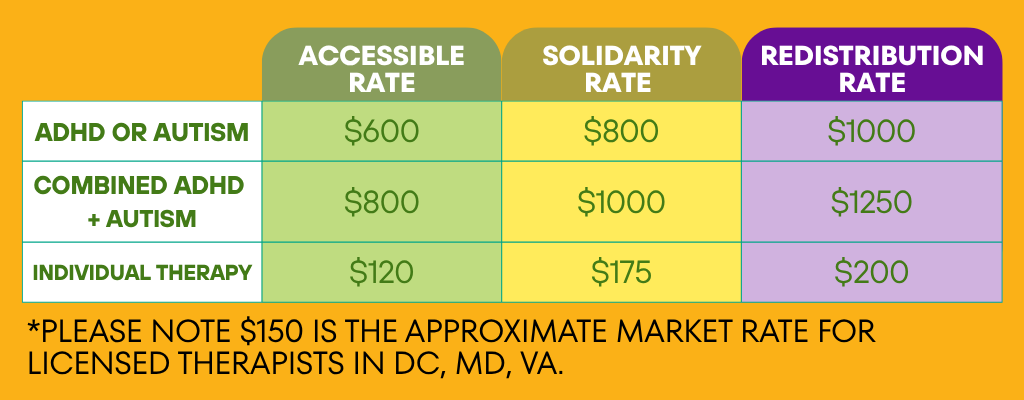
I use an equitable pricing model because access to diagnostic evaluations should not be limited to people with substantial financial resources.
You're invited to consider your financial circumstances and choose the rate most appropriate for you.